
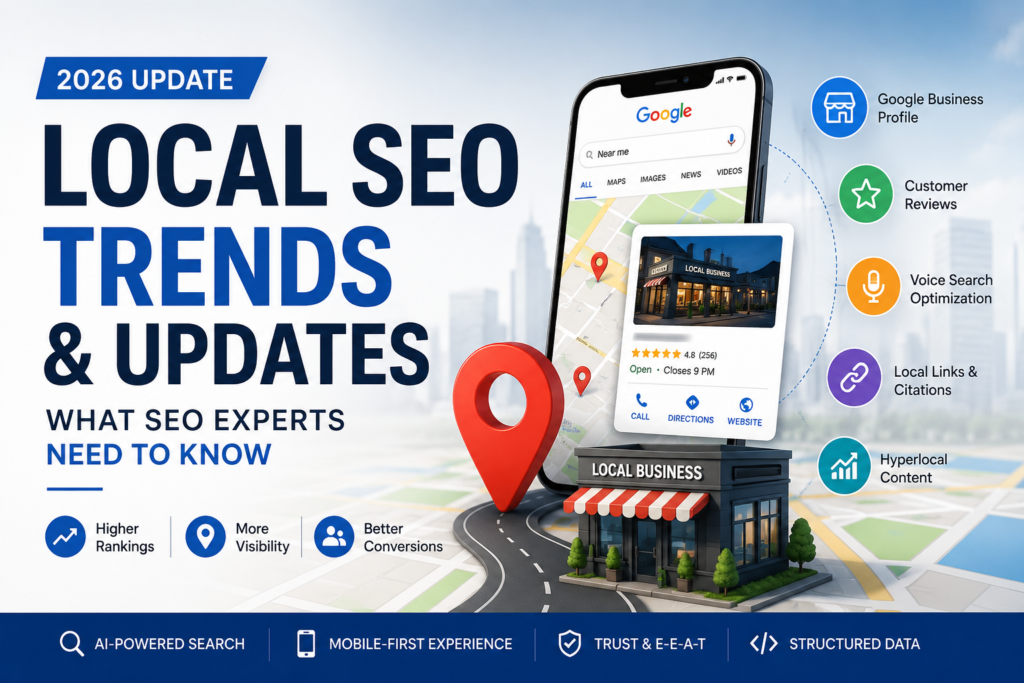
Local SEO continues to evolve as Google becomes better at understanding user intent, location, and business credibility. In 2026, ranking in the Google Local Pack requires more than simply optimizing a Google Business Profile. SEO professionals must now focus on user experience, AI-powered search, customer engagement, and hyper-local relevance.
Here’s a look at the latest Local SEO trends and updates every SEO expert should know.
1. AI-Powered Local Search is Changing User Behavior
Google’s AI-driven search experience is transforming how users discover local businesses. Instead of searching with simple keywords like “coffee shop near me,” users now ask conversational questions such as “Which café nearby has free Wi-Fi and is good for remote work?”
SEO experts should optimize content around natural language queries, FAQs, and long-tail conversational keywords. Structured data and detailed business information help AI understand and recommend your business more effectively.
2. Google Business Profile Remains the Foundation
A fully optimized Google Business Profile (GBP) is still the most important ranking factor for local businesses.
Best practices include:
- Selecting the most accurate primary and secondary categories.
- Posting weekly updates, offers, and events.
- Uploading high-quality images and videos regularly.
- Keeping business hours updated, including holiday timings.
- Responding to customer reviews promptly.
Businesses that actively manage their profiles tend to achieve higher visibility in Google’s Local Pack.
3. Customer Reviews Carry More Weight Than Ever
Reviews influence both rankings and customer trust. Google increasingly evaluates review quality rather than simply counting the number of reviews.
SEO experts should encourage customers to leave detailed reviews mentioning:
- Specific services
- Products purchased
- Staff members
- Location references
- Overall customer experience
Responding professionally to both positive and negative reviews signals active business management and improves credibility.
4. Hyperlocal Content is Driving Rankings
Generic city-based landing pages are becoming less effective. Google now rewards businesses that publish highly localized content.
Examples include:
- Neighborhood guides
- Community event coverage
- Local case studies
- Area-specific service pages
- Customer success stories
Hyperlocal blogs demonstrate local expertise and help businesses appear for location-specific searches with lower competition.
5. Voice Search Optimization is Essential
Voice assistants continue to influence local searches.
Common voice queries include:
- “Where is the nearest dentist?”
- “Which bakery is open now?”
- “Best digital marketing institute near me.”
Voice searches tend to be longer and more conversational. Optimizing for question-based keywords, FAQ pages, and concise answers improves visibility in voice search results.
6. Local Citations Need Accuracy, Not Quantity
While citations remain important, consistency is now more valuable than submitting listings to hundreds of directories.
Ensure that your:
- Business Name
- Address
- Phone Number (NAP)
- Website URL
- Business Categories
remain identical across all online directories. Even small inconsistencies can reduce Google’s confidence in business information.
7. Local Link Building Focuses on Community Authority
Google values locally relevant backlinks more than generic directory links.
Effective local link-building opportunities include:
- Local news websites
- Community organizations
- Business associations
- Chamber of Commerce websites
- Local bloggers
- Event sponsorships
- Educational institutions
Relevant local backlinks improve both authority and geographic relevance.
8. Mobile Experience is a Critical Ranking Signal
Most local searches occur on smartphones, making mobile optimization essential.
SEO experts should ensure:
- Fast loading speed
- Responsive design
- Click-to-call buttons
- Easy navigation
- Optimized Core Web Vitals
- Mobile-friendly forms
A poor mobile experience can significantly reduce conversions, even if rankings remain strong.
9. Structured Data Improves Local Visibility
Schema markup helps search engines understand business information more accurately.
Important schema types include:
- LocalBusiness
- Organization
- FAQ
- Review
- Product
- Service
- Event
Proper structured data can improve eligibility for rich search results and increase click-through rates.
10. E-E-A-T is Influencing Local Rankings
Google increasingly evaluates Experience, Expertise, Authoritativeness, and Trustworthiness (E-E-A-T) when ranking local businesses.
Businesses can strengthen E-E-A-T by:
- Publishing expert-written content.
- Displaying certifications and awards.
- Showcasing real customer testimonials.
- Highlighting team expertise.
- Maintaining transparent contact information.
- Updating website content regularly.
Trust signals are becoming as important as traditional SEO factors.
Final Thoughts
Local SEO in 2026 is no longer just about keywords and directory listings. Google’s AI-powered search ecosystem rewards businesses that provide accurate information, exceptional customer experiences, localized content, and genuine authority within their communities.
For SEO experts, success depends on combining technical optimization with reputation management, content strategy, structured data, and continuous Google Business Profile optimization. Those who adapt to these evolving trends will be better positioned to dominate local search results, attract high-intent customers, and generate sustainable business growth in an increasingly competitive digital landscape.